Table of Contents
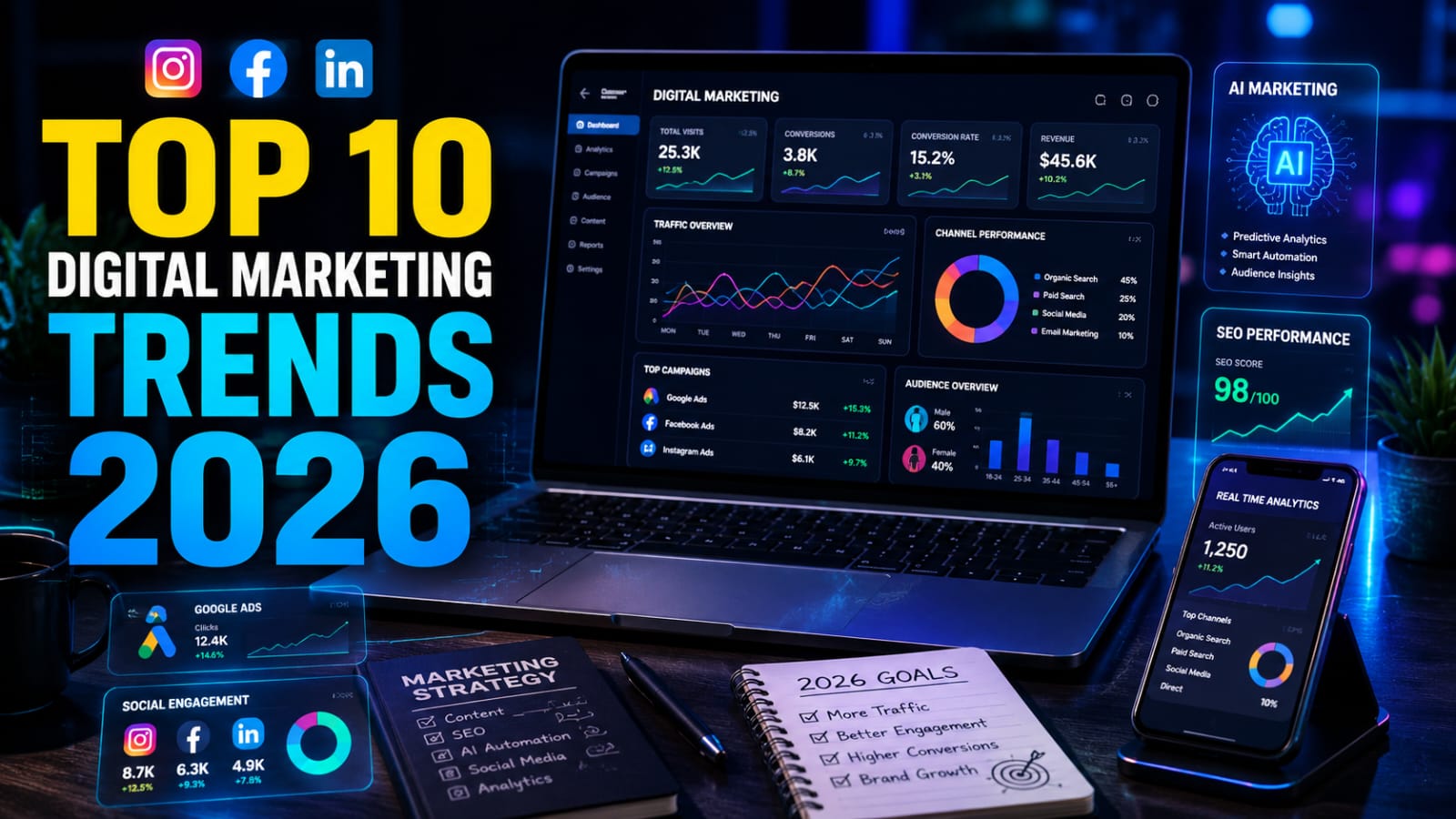
The digital marketing landscape is evolving faster than ever. As we move deeper into 2026, businesses that fail to adapt to emerging trends risk falling behind competitors who embrace innovation. From AI-driven automation to the rise of zero-click content, the rules of digital engagement are being rewritten.
In this comprehensive guide, we break down the 10 most impactful digital marketing trends that every business — whether a startup or an enterprise — must implement to stay relevant, competitive, and profitable in 2026.
1. AI-Powered Marketing Automation
Artificial intelligence has moved beyond novelty to become the backbone of modern marketing operations. In 2026, AI-powered tools are automating everything from email segmentation and ad bidding to content creation and customer journey mapping. Businesses using AI automation report up to 40% reduction in customer acquisition costs and a 30% increase in conversion rates.
The key is not replacing human creativity but amplifying it. AI handles repetitive tasks — A/B testing, audience segmentation, bid optimization — while your team focuses on strategy, storytelling, and brand building. Tools like predictive analytics platforms now forecast customer behavior with remarkable accuracy, enabling proactive rather than reactive marketing.
"AI doesn't replace marketers. It amplifies the ones who know how to use it."
2. Short-Form Video Dominance
Short-form video content on platforms like Instagram Reels, TikTok, and YouTube Shorts continues to dominate engagement metrics. In 2026, brands that invest in authentic, raw, and entertaining short-form videos are seeing 3-5x higher engagement compared to static posts or long-form content.
The formula is simple: hook viewers in the first 1.5 seconds, deliver value in under 30 seconds, and include a clear call-to-action. User-generated content (UGC) style videos are outperforming polished studio productions, as audiences crave authenticity over perfection.
3. Voice Search Optimization
With smart speakers and voice assistants now in over 50% of households, voice search is fundamentally changing how people find information online. By 2026, an estimated 55% of all searches will be voice-based. This means optimizing for conversational long-tail keywords, featured snippets, and local SEO has never been more critical.
Voice queries are typically longer and more conversational than typed queries. Instead of optimizing for "best marketing agency," focus on phrases like "what's the best digital marketing agency near me for small businesses." Structured data markup and FAQ pages become essential tools for capturing voice search traffic.
4. First-Party Data Strategies
As third-party cookies phase out and privacy regulations tighten globally, first-party data has become the most valuable asset in a marketer's toolkit. Brands that build robust zero-party and first-party data collection systems — through quizzes, surveys, loyalty programs, and interactive content — will have a decisive competitive advantage.
Invest in Customer Data Platforms (CDPs) that unify data across touchpoints. The brands winning in 2026 are those that can create a single customer view without relying on invasive tracking methods. Transparency and value exchange are the new currency of data collection.
5. Hyper-Personalization at Scale
Generic marketing messages are dead. In 2026, consumers expect personalized experiences at every touchpoint — from tailored email subject lines to dynamic website content that adapts in real-time based on user behavior. AI makes this possible at scale.
Dynamic creative optimization (DCO) automatically generates thousands of ad variations tailored to different audience segments. Personalized landing pages adjust content based on the visitor's industry, company size, and past interactions. The result: higher engagement, lower bounce rates, and significantly better conversion rates.
6. AI-Generated Ad Creative
AI video and image generation tools have matured to the point where brands can produce hundreds of ad creative variants in hours rather than weeks. From AI-generated product videos to synthetic brand ambassadors, the creative production pipeline has been completely transformed.
The most effective approach combines AI generation with human curation. Use AI to produce initial drafts and variations, then have your creative team refine and approve the final output. This hybrid model delivers both speed and quality — producing 10x more creative at 85% lower cost.
"The brands that win in 2026 are the ones that produce 1,000 variations instead of 10."
7. Conversational Marketing
AI chatbots and conversational AI have evolved from basic FAQ responders to sophisticated sales and support agents. In 2026, conversational marketing — using real-time, one-to-one conversations across chat, voice, and messaging platforms — is driving 3-5x higher lead qualification rates.
Implement AI-powered chatbots on your website that can qualify leads, book meetings, and provide instant support. Integrate WhatsApp Business API for direct customer communication. The brands that make it easiest to start a conversation are the ones that convert the most customers.
8. Zero-Click Content
Social media algorithms increasingly reward content that keeps users on-platform. Zero-click content — posts that deliver complete value without requiring a click-through — is now the highest-performing content format across LinkedIn, Instagram, and TikTok.
This means sharing full insights, complete tips, and actionable advice directly in your posts rather than teasing content with a "link in bio." Build brand authority and trust through generosity. The clicks will follow when audiences are ready to engage further.
9. Sustainability Storytelling
Modern consumers — especially Gen Z and Millennials — increasingly choose brands based on environmental and social values. In 2026, authentic sustainability storytelling is not just good ethics; it's good business. Brands with genuine purpose-driven narratives see 2x higher customer loyalty.
Avoid greenwashing. Instead, document your actual sustainability journey — the progress, the challenges, and the commitments. Use video content to showcase behind-the-scenes efforts. Transparency builds trust, and trust drives long-term brand equity.
10. Omnichannel Attribution
As customer journeys become increasingly complex — spanning social media, search, email, offline interactions, and multiple devices — accurate omnichannel attribution has become essential for optimizing marketing spend. Businesses that can accurately attribute conversions across channels are allocating budgets 30% more efficiently.
Invest in multi-touch attribution models and marketing mix modeling. Unified analytics platforms that track the entire customer journey — from first impression to final conversion — provide the insights needed to maximize ROI. The era of single-channel attribution is over.
Conclusion
The digital marketing trends of 2026 share a common thread: the intersection of AI technology and human authenticity. Businesses that leverage AI for efficiency while maintaining genuine, value-driven content will dominate their markets.
Start implementing these trends today. You don't need to tackle all ten at once — pick the three that align most closely with your business goals and build from there. The future belongs to marketers who are both data-driven and human-centered.
With over 8 years of experience in performance marketing and brand strategy, Sunil helps businesses scale through data-driven digital campaigns across Google, Meta, and emerging platforms.